Does CopperTheory ship to New Zealand?
Yes. CopperTheory ships to New Zealand through its international fulfilment network. Delivery options, charges and the final order total are confirmed at checkout.
This guide explains copper peptides for hair as a practical scalp routine, then shows how GHK-Cu Hair Serum, shampoo and conditioner work together for scalp care, density and hairline support.
The goal is a repeatable scalp-first routine: cleanse when needed, condition for softness, then use a focused leave-on serum step where the scalp needs it most.
Copper peptides for hair work best as a clear scalp-first routine. GHK-Cu Hair Serum is the focused leave-on scalp step for thinning hair, density, hairline and crown support, while GHK-Cu Shampoo and Conditioner cleanse and soften. Applying the serum directly to the scalp, consistently, is what keeps the routine effective.
This guide explains copper peptides for hair as a practical scalp routine, then shows how GHK-Cu Hair Serum, shampoo and conditioner work together for scalp care, density and hairline support.
It comes down to one habit: part the hair, apply GHK-Cu Hair Serum to the scalp, and keep doing it regularly, with shampoo and conditioner supporting around it.
In plain English, copper peptides for hair means a scalp routine, not a strand treatment. GHK-Cu Hair Serum is the leave-on step you apply straight to the scalp, while GHK-Cu Shampoo and Conditioner cleanse and soften.
The scalp is the focus because that is where the leave-on step is placed. Shampoo and conditioner support the routine, but they do not replace direct scalp application.
Start by defining the ingredient, structure, product category or route being discussed.
Separate laboratory, preclinical, human, regulatory and professional guidance according to what each source actually supports.
Ingredient research or a mechanistic explanation does not automatically prove a finished product will deliver a guaranteed outcome.
On wash days the order is GHK-Cu Shampoo to cleanse the scalp, GHK-Cu Conditioner through the lengths, then GHK-Cu Hair Serum parted onto the scalp once it is towel-dried.
On non-wash days you usually skip straight to the serum - part, apply, massage in. Keeping that leave-on scalp step going between washes is what makes the routine consistent for density, hairline and crown support.
The serum pairs with the shampoo and conditioner as a simple wash-day set, plus regular non-wash-day application. Keep heavy oils and styling buildup off the scalp beforehand, since they coat it and reduce how well the serum makes contact.
Avoid overhauling everything at once - a scalp routine is easier to judge when only the serum habit is being built. Consistency on the scalp beats piling on extra products.
Compare evidence from similar routes, formulations, populations and outcomes rather than combining unlike categories.
A plausible biological mechanism can support a hypothesis without proving a visible or clinical result in a finished product.
Cosmetic education can explain topical use, but diagnosis, injections, medicines and treatment decisions require qualified professional guidance.
The core mistake is applying GHK-Cu Hair Serum to the hair lengths instead of parting and placing it on the scalp, so the one step that targets the scalp is wasted on strands. Another is inconsistent use - a few days on, a week off - when a scalp routine depends on steady application.
People also let buildup from oils and styling products coat the scalp so the serum cannot make good contact, or change several products at once. Keep the serum on the scalp, keep it regular, and keep the scalp accessible.
Hair grows slowly, so a scalp routine is best judged over months of consistent use, not weeks. In the early days you are mainly building the habit and checking scalp comfort. Try not to restart the routine every time you swap in a new product.
The practical goal is a repeatable scalp-first routine you can maintain, with visible changes assessed across the full skin or hair cycle. Many people find that consistency - applying to the scalp regularly - is the single most important factor.
Identify whether a source is laboratory, preclinical, human, regulatory or professional guidance.
Check whether the evidence concerns the same ingredient, concentration, delivery route, formula and outcome being discussed.
State what is supported, what is only plausible and what remains unknown instead of presenting all evidence as equal.
This is for anyone focused on their scalp and hair - people thinking about density, the hairline or crown, or thinning - who want a clear leave-on scalp step plus cleansing and conditioning that support it, rather than a random pile of products.
This guide provides practical topical-product and routine guidance grounded in the ingredient roles, formula design and evidence discussed throughout the page. Published hair research includes human hair-follicle and dermal-papilla research on AHK-Cu, a different tripeptide-copper complex and a six-month placebo-controlled human study of a 5-ALA and GHK peptide complex. Together, they provide relevant ingredient-level and human evidence for copper-peptide hair routines.
The takeaway is that copper peptides for hair work as a scalp-first routine: GHK-Cu Hair Serum applied directly to the scalp as the leave-on step, with shampoo and conditioner cleansing and softening around it. Direct application and consistency are what matter.
Part the hair, apply to the scalp, keep it regular, and let the wash-day steps support the routine. Give it patient, consistent use before judging.
The products and guides below are included only where they directly relate to the question explained on this page.
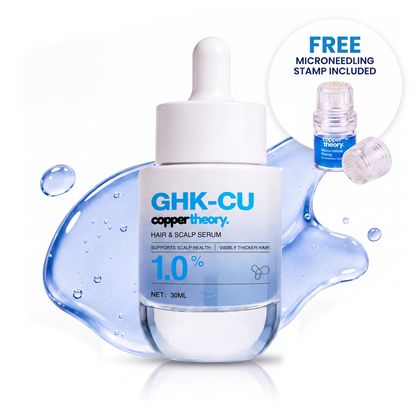
The focused leave-on scalp serum step for CopperTheory hair and scalp routines.
Shop GHK-Cu Hair Serum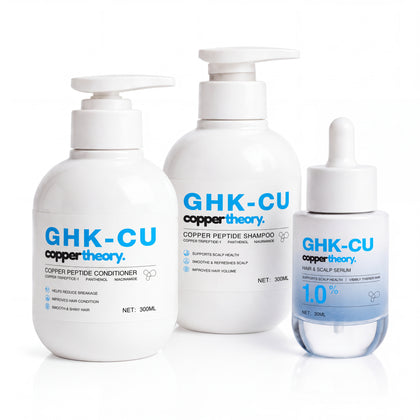
The complete CopperTheory hair routine with shampoo, conditioner and serum.
Shop Hair RoutineLearn where the leave-on serum fits and how to apply it to the scalp.
Read: How to Use GHK-Cu Hair SerumUnderstand the scalp-first role of CopperTheory hair serum.
Read: GHK-Cu for Scalp CareSee how GHK-Cu connects to hair and scalp routines.
Read: Copper Peptides for HairBuild a simple wash-day and non-wash-day routine.
Read: Complete Hair Routine ChecklistSee how CopperTheory explains ingredient roles clearly.
Read: Ingredient TransparencyInline citations connect specific statements to primary research, regulatory documents or professional guidance. CopperTheory’s current ingredient lists and formula records are tested, verified and disclosed; the source labels below show whether the supporting evidence is ingredient-level, preclinical, human, regulatory or professional guidance.
Copper Peptides for Hair: The Complete GHK-Cu Scalp Routine Guide is about building a clearer CopperTheory hair and scalp routine, where shampoo and conditioner support cleansing and softness while GHK-Cu Hair Serum is the focused leave-on scalp step.
Apply GHK-Cu Hair Serum directly to the scalp, not the lengths - part the hair and massage it into the scalp where support is wanted. It is a leave-on step, so it stays on rather than being rinsed out.
Hair grows slowly, so a scalp routine is judged over months of consistent use rather than weeks. The practical goal is steady, repeatable application, with visible changes assessed across the full skin or hair cycle.
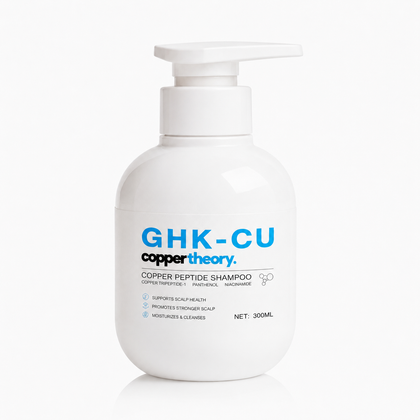
Yes, as support. GHK-Cu Shampoo cleanses the scalp so the serum has good contact, and conditioner softens the lengths. The leave-on scalp serum stays the focused step around them.
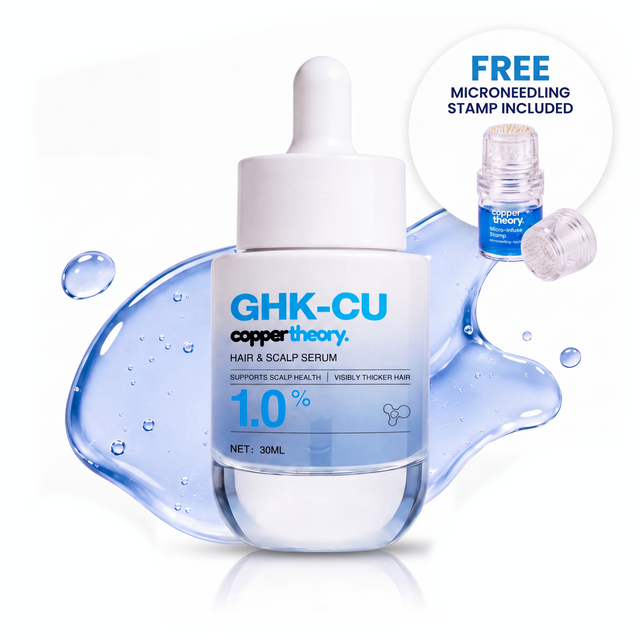
CopperTheory GHK-Cu Copper Peptide Hair Growth Serum is the targeted leave-in scalp step for thinning-looking areas, including the hairline, temples and crown. Its Copper Tripeptide-1, Acetyl Tetrapeptide-3 and Red Clover system is designed to support fuller-looking density, scalp condition and a consistent hair-growth routine for men and women. View GHK-Cu Copper Peptide Hair Growth Serum.
Make a parting to expose a line of scalp, apply GHK-Cu Hair Serum along it, then part again a little further over and repeat across the area. Massaging gently helps spread it over the scalp rather than the strands.
Regular, steady use is what a scalp routine depends on, including on non-wash days. Follow the product directions for frequency, and treat consistency over weeks and months as the priority rather than occasional heavy use.
The serum is the hero, but shampoo keeps the scalp clean and accessible and conditioner looks after the lengths, so both support the routine. A clean scalp helps the leave-on serum make better contact.
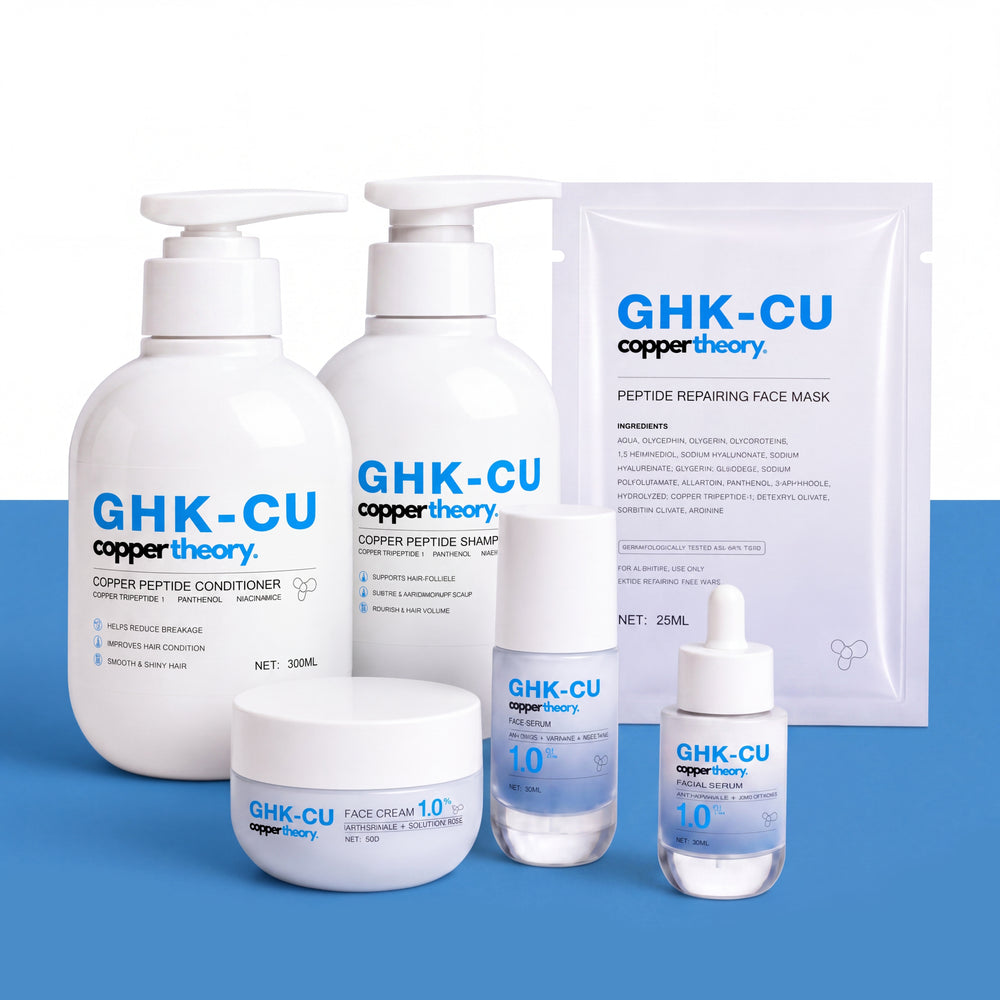
Make GHK-Cu Hair Serum the leave-on scalp step, add GHK-Cu Shampoo and Conditioner to cleanse and soften, or start with the Complete GHK-Cu Hair Care Routine for the whole scalp routine in one place.
COPPERTHEORY IN NZ
CopperTheory—also written as Copper Theory—is an Australian-owned GHK-Cu skincare, hair care and scalp care brand that ships worldwide. This storefront is set for New Zealand and displays prices in New Zealand dollars (NZD).
Yes. CopperTheory ships to New Zealand through its international fulfilment network. Delivery options, charges and the final order total are confirmed at checkout.
Product prices on this market are shown in New Zealand dollars (NZD). Your checkout keeps the selected market and currency together.
Yes. Shopify Markets applies the price, currency and product availability configured for New Zealand. These can differ from another country’s storefront.