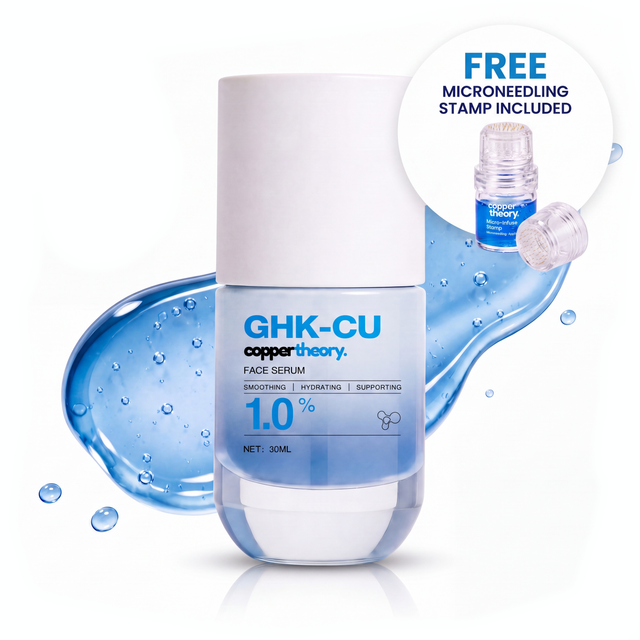
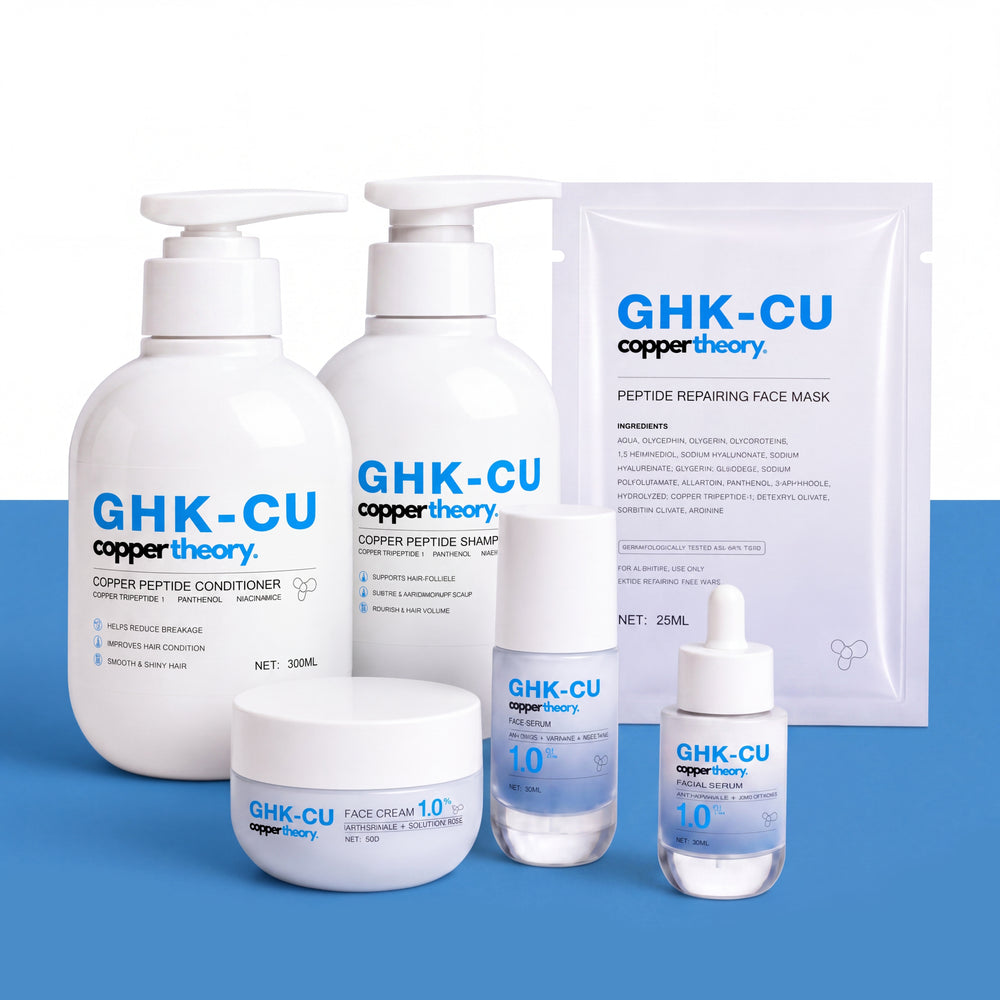
CopperTheory Ingredient Reference

CopperTheory Ingredient Dictionary

This dictionary explains every verified ingredient across CopperTheory's formulas — what each one is, its cosmetic role, and why it is included. The hero across the range is Copper Tripeptide-1 (GHK-Cu); on hair it is joined by Acetyl Tetrapeptide-3 and Red Clover for fuller density, and across skin and scalp by hydration, barrier and conditioning ingredients. See the GHK-Cu Face Serum product page for its full verified INCI.

Use it to understand what is in your product and why. Every entry is derived from the verified formula and kept to a cosmetic level — no invented concentrations, testing or branded raw-material claims.

For how we formulate and talk about evidence, see Ingredient Transparency. To understand the hero peptide, see What Is GHK-Cu?.

Copper peptidesHydrationBarrier lipidsConditioning
1.4% GHK-Cu Face Serum for Wrinkles, Firmness & Hydration – 30 mL
Clear answerThe direct answer appears before the supporting explanation.
Category clarityIngredients, finished cosmetics, preclinical findings, human evidence and medical use are not treated as interchangeable.
Practical meaningThe guide explains what the evidence can reasonably mean for a topical routine.
Limits statedUncertainty and evidence limits are kept visible instead of being turned into guarantees.
01

Clear answer

Copper Tripeptide-1 (GHK-Cu) is the hero copper-binding peptide. On skin it anchors firming and renewal-supporting positioning; on the scalp it supports scalp condition, renewal signalling and the environment surrounding the hair follicle. It appears across the range.

On hair, Acetyl Tetrapeptide-3 supports the structures around the hair root and Trifolium Pratense (Red Clover) Flower Extract adds botanical scalp-conditioning support — together the density-focused pairing in the Hair Serum. Acetyl Hexapeptide-8 is a supporting peptide in the Face Serum that broadens the anti-ageing peptide system for smoother texture.

These are cosmetic ingredients used topically. They support condition and appearance; they do not treat medical conditions, block DHT or state fixed outcomes without appropriate product-level evidence.

Main takeaway: Copper Tripeptide-1 is the hero; Acetyl Tetrapeptide-3 and Red Clover carry hair density; Acetyl Hexapeptide-8 supports skin texture.

Key points

  • The direct answer to the question
  • What is being explained or compared
  • The type and strength of supporting evidence
  • Important limits or uncertainty
  • The practical takeaway without overclaiming
02

What this means in plain English

Hydration comes from humectants. Sodium Hyaluronate is a water-binding form of hyaluronic acid delivering lightweight hydration; Hydrolyzed Sodium Hyaluronate replenishes hydration at a different level of the formula. Glycerin and Butylene Glycol attract water and help distribute the formula evenly.

In the Face Mask, Sodium Polyglutamate is a moisture-binding polymer that reduces water loss, and Glycereth-26 and Glyceryl Glucoside add to a multi-humectant system for a softer, more hydrated finish.

What it is

Start by defining the ingredient, structure, product category or route being discussed.

What evidence can show

Separate laboratory, preclinical, human, regulatory and professional guidance according to what each source actually supports.

What it cannot prove

Ingredient research or a mechanistic explanation does not automatically prove a finished product will deliver a guaranteed outcome.

03

Practical context

Barrier support comes from skin-identical lipids. Ceramide NP, Cholesterol and Phytosphingosine form the lipid system in the Face Cream that replenishes the barrier and improves moisture retention — the lipids skin's own barrier is built from.

Emollients soften and nourish: Squalane and Argania Spinosa (Argan) Kernel Oil reduce the dry, tight feel of depleted skin, and Caprylic/Capric Triglyceride is a lightweight emollient that improves softness and spread. Hydrolyzed Rice Protein adds a smoothing, conditioning finish.

Main takeaway: Keep ingredient theory, finished-product evidence, cosmetic use and medical use in their correct categories.

Key points

  • Define the exact question before comparing evidence.
  • Separate topical cosmetics from injections, medicines and clinical procedures.
  • Distinguish ingredient-level findings from evidence on a finished formula.
  • Consider concentration, delivery, contact time and study population.
  • Use a qualified professional for medical decisions rather than extending cosmetic guidance beyond its scope.
04

What to compare and what to keep separate

Conditioning and comfort ingredients round out the formulas. Panthenol (pro-vitamin B5) binds moisture and conditions skin, scalp and hair; Niacinamide supports the skin and scalp barrier, moisture retention, tone and texture; Allantoin soothes and conditions dry or stressed skin and scalp; Arginine conditions and supports fibre resilience and formula balance.

In the Conditioner, Cetearyl Alcohol softens and improves slip, Behentrimonium Chloride and Stearamidopropyl Dimethylamine improve detangling and manageability, and Dimethicone and Cyclopentasiloxane add slip and smoothness. These ingredients are chosen to work together within each verified formula.

Compare like with like

Compare evidence from similar routes, formulations, populations and outcomes rather than combining unlike categories.

Separate mechanism from outcome

A plausible biological mechanism can support a hypothesis without proving a visible or clinical result in a finished product.

Keep scope visible

Cosmetic education can explain topical use, but diagnosis, injections, medicines and treatment decisions require qualified professional guidance.

05

Common mistakes to avoid

A common misconception is that a longer ingredient list is automatically better — what matters is the role each ingredient plays. Another is assuming an ingredient in one product is in all of them; membership varies by formula, and this dictionary states it per verified INCI.

Every current CopperTheory ingredient is tied to a tested and verified formula record and disclosed in the product’s full INCI. Concentration statements, branded raw-material claims and clinical outcomes are included only when the relevant documentation verifies them; nothing is borrowed or guessed.

Main takeaway: The strongest conclusion is the one the available evidence actually supports.

Key points

  • Treating ingredient research as finished-product clinical proof
  • Treating laboratory or preclinical findings as confirmed human outcomes
  • Comparing topical cosmetics directly with injections, medicines or procedures
  • Ignoring formulation, concentration, delivery and contact time
  • Turning uncertainty into a guaranteed claim or forced product conclusion
06

How to judge the evidence without guessing

Ingredients support the look and feel of skin, scalp and hair — hydration, comfort, firmness, texture, density. They are cosmetic, and results build with consistent use rather than overnight. The evidence base includes a PubMed review of GHK/GHK-Cu research and a review of GHK-Cu regenerative and protective research. CopperTheory connects that ingredient research to its tested, verified and disclosed topical formula.

To see which product contains a given ingredient, check that product's page — each lists its full verified INCI. For how ingredients are selected and described, see Ingredient Transparency.

Evidence type

Identify whether a source is laboratory, preclinical, human, regulatory or professional guidance.

Product relevance

Check whether the evidence concerns the same ingredient, concentration, delivery route, formula and outcome being discussed.

Conclusion strength

State what is supported, what is only plausible and what remains unknown instead of presenting all evidence as equal.

07

Who this guide is for

This reference is for anyone who wants to understand their routine — which ingredient does what, and why it is in the formula. It supports informed choices across the skin, hair and scalp ranges.

Pair it with the Ingredient Compatibility guidance and the layering guide to plan how products work together in a routine.

Key points

  • People comparing ingredients, product categories or delivery routes
  • People trying to understand the strength of a claim
  • People separating cosmetic guidance from medical discussion
  • People who want uncertainty and evidence limits stated clearly
  • People deciding what the available evidence means in practice
08

Key summary

Every CopperTheory formula is built around Copper Tripeptide-1, supported by a considered cast: density peptides on hair, barrier lipids and emollients on skin, and hydration and conditioning ingredients throughout.

Each ingredient has a defined cosmetic role, stated from the verified formula. For the full policy on how we formulate and describe ingredients, read Ingredient Transparency.

Main takeaway:Know your ingredients: one hero peptide, supported by hydration, barrier and conditioning actives — each in a defined role.
Next steps

Continue with the relevant evidence and practical context

The products and guides below are included only where they directly relate to the question explained on this page.
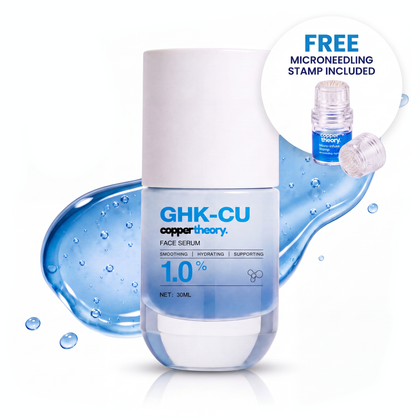
1.4% GHK-Cu Face Serum for Wrinkles, Firmness & Hydration – 30 mL

GHK-Cu Face Serum

Copper Tripeptide-1, Acetyl Hexapeptide-8, niacinamide and two forms of hyaluronic acid — the treatment step.

Shop the Face Serum
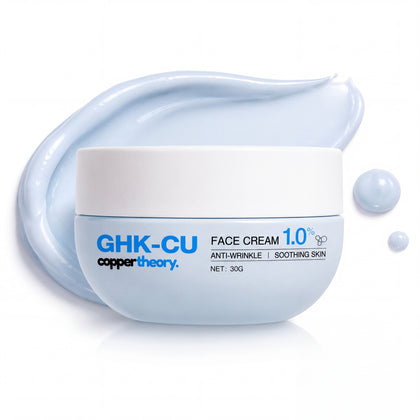
1.4% GHK-Cu Face Cream for Wrinkles, Firmness & Barrier Repair – 30 g

GHK-Cu Face Cream

Copper Tripeptide-1 with the ceramide-cholesterol-phytosphingosine barrier system — the sealing step.

Shop the Face Cream
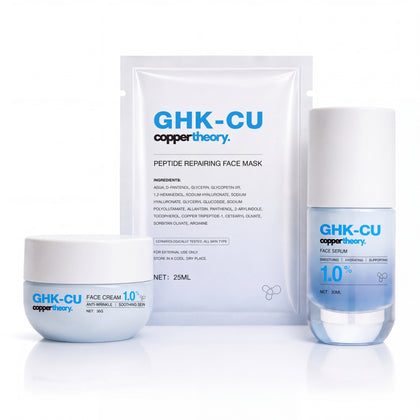
Complete 3-Step GHK-Cu Skincare Routine for Wrinkles, Firmness & Hydration

Complete GHK-Cu Skincare Routine

The full skincare routine — cleanser, serum, cream and mask in the right order.

Build the routine

Ingredient Transparency

How we formulate and talk about evidence.

Read: Ingredient Transparency

What Is GHK-Cu?

The hero peptide explained — what GHK-Cu is.

Read: What Is GHK-Cu?

Ingredient Compatibility Chart

Which ingredients and steps work together.

Read: Ingredient Compatibility Chart

Strong Copper Peptide Formula

Why the copper peptide formula is built the way it is.

Read: Strong Copper Peptide Formula

How to Layer GHK-Cu Serum

How to layer copper peptides with other actives.

Read: How to Layer GHK-Cu Serum

Shop CopperTheory Skincare

Shop the full GHK-Cu skincare range.

Shop CopperTheory Skincare
Evidence

Sources and further reading

Inline citations connect specific statements to primary research, regulatory documents or professional guidance. CopperTheory’s current ingredient lists and formula records are tested, verified and disclosed; the source labels below show whether the supporting evidence is ingredient-level, preclinical, human, regulatory or professional guidance.

  1. The potential of GHK as an anti-aging peptide (PMID 35083444)
  2. Regenerative and protective GHK-Cu research review (PMID 29986520)
  3. American Academy of Dermatology — healthy hair guidance
  4. American Academy of Dermatology — skin-care order guidance
  5. American Academy of Dermatology — sunscreen guidance
  6. Human hair-follicle study of AHK-Cu, a different tripeptide-copper complex (PMID 17703734)
  7. Preclinical topical GHK-Cu delivery study (PMID 38026438)
FAQ

CopperTheory Ingredient Dictionary FAQ

What is the hero ingredient in CopperTheory products?

Copper Tripeptide-1 (GHK-Cu) — a naturally occurring copper peptide used topically to support skin condition and, on the scalp, the environment surrounding the hair follicle.

What do Acetyl Tetrapeptide-3 and Red Clover do?

In the Hair Serum, Acetyl Tetrapeptide-3 supports the structures around the hair root and Red Clover adds botanical scalp-conditioning support — together the density-focused pairing. They are not labelled with a branded complex name.

Which ingredients provide hydration?

Sodium Hyaluronate, Hydrolyzed Sodium Hyaluronate, Glycerin and Butylene Glycol across the range; the Face Mask adds Sodium Polyglutamate and Glyceryl Glucoside.

What are the barrier ingredients in the Face Cream?

Ceramide NP, Cholesterol and Phytosphingosine — a skin-lipid system that replenishes the barrier — plus emollients Squalane, Argan Oil and Caprylic/Capric Triglyceride.

How do I know which product contains an ingredient?

Yes. The dictionary covers the key ingredients used across current CopperTheory formulas, and every current product page discloses its full verified INCI. Product membership and ingredient roles are checked against the product-specific formula record.

Do you list concentrations?

No. We describe each ingredient's cosmetic role but do not publish concentrations, branded raw-material claims or clinical results.

Can I use copper peptides with moisturiser?

Yes. Moisturiser or face cream is a simple support step after copper peptide serum.

Should I use sunscreen?

Yes. Use sunscreen during the day as the final morning step.

Understand every ingredient in your routine

Explore the range built around Copper Tripeptide-1, or read Ingredient Transparency for our formulation approach.

COPPERTHEORY IN AU

Shopping CopperTheory in Australia

CopperTheory—also written as Copper Theory—is an Australian-owned GHK-Cu skincare, hair care and scalp care brand that ships worldwide. This storefront is set for Australia and displays prices in Australian dollars (AUD).

Does CopperTheory ship to Australia?

Yes. CopperTheory ships to Australia through its international fulfilment network. Delivery options, charges and the final order total are confirmed at checkout.

What currency will I pay in?

Product prices on this market are shown in Australian dollars (AUD). Your checkout keeps the selected market and currency together.

Are price and availability localised?

Yes. Shopify Markets applies the price, currency and product availability configured for Australia. These can differ from another country’s storefront.