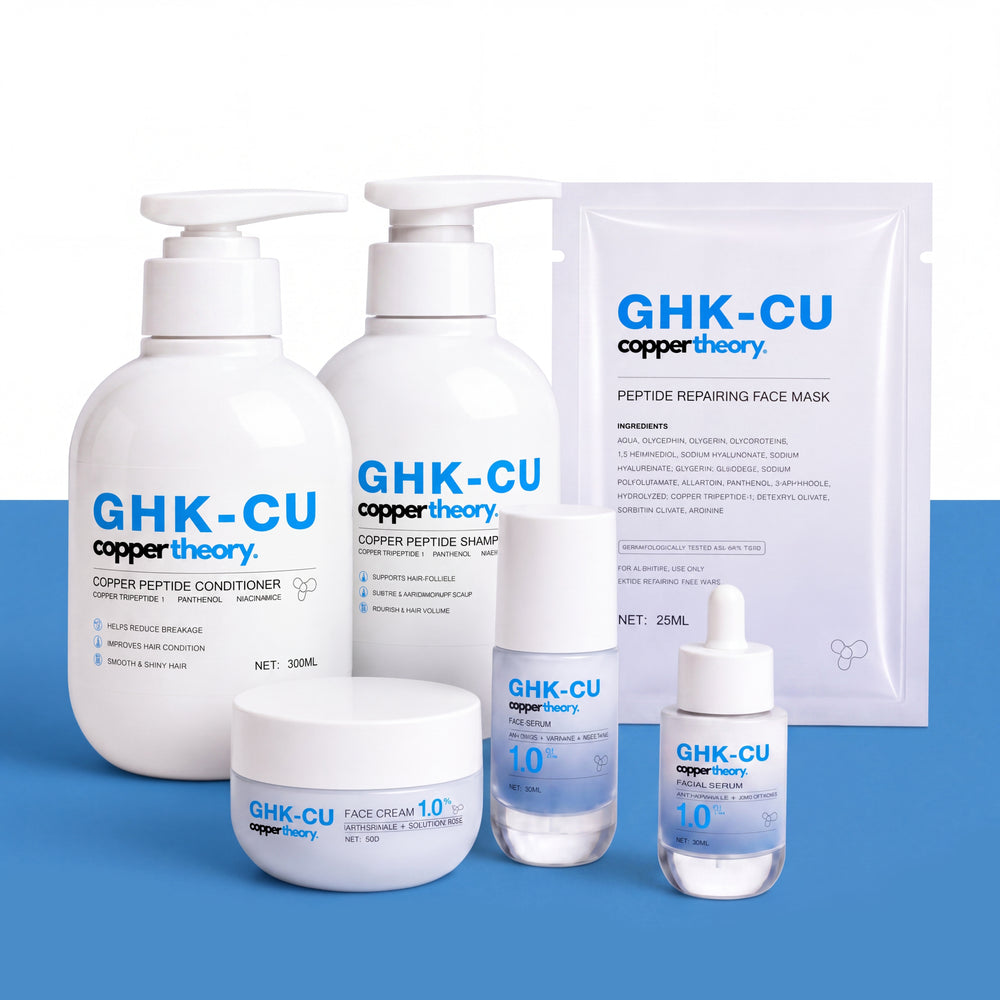
Ingredient transparency you can actually check.
This page shows which formula percentages CopperTheory declares, what evidence applies to each product, where ingredient research stops, and how technical product documentation is handled for professional and regulatory review.
- Product-specific percentages
- Full INCI on product pages
- Evidence types kept separate
- Controlled technical-document access
Four different records. Four different meanings.
A percentage in a formula, a result measured on the finished product, a participant opinion and a published ingredient study do not prove the same thing. CopperTheory labels them separately.
Formula record
Confirms the declared ingredient input or concentration used for that exact product. It does not by itself prove a visible result.
Finished-product result
A measurement or performance assessment on the named finished formula, with its own method and timeframe.
Participant feedback
The percentage of users reporting an experience. It is subjective feedback, not the same as an instrumental measurement.
Ingredient research
Explains why an ingredient may be included. It cannot automatically be treated as proof for the complete CopperTheory formula.
Declared formula levels and available evidence
These are the current declared formula levels used across the core range. Open the linked product for the full INCI, directions, results and product-specific evidence notes.
- 1.4% GHK-Cu
- 2% Acetyl Tetrapeptide-3
- 2% Red Clover Extract
- 2% Niacinamide
- 1% Panthenol
Review Hair Serum evidence →
- 1% GHK-Cu
- 7% SLES
- 8% Cocamidopropyl Betaine
- 2.5% SCI
- 1% Niacinamide
- 0.75% Panthenol
Review Shampoo evidence →
- 1% GHK-Cu
- 4% Cetearyl Alcohol
- 1% Behentrimonium Chloride
- 0.75% Niacinamide
- 0.5% Panthenol
- 0.6% Dimethicone
Review Conditioner evidence →
- 1.4% GHK-Cu
- 10% Argireline solution as supplied
- 4% Niacinamide
- 1% Panthenol
- 0.08% Sodium Hyaluronate
Review Face Serum evidence →
- 1.4% GHK-Cu
- 2.5% barrier-lipid complex
- 4% Squalane
- 4% Niacinamide
- 1.5% Panthenol
- 1.5% Argan Oil
Review Face Cream evidence →
- GHK-Cu disclosed
- Multi-humectant system disclosed
- Exact peptide percentage not publicly declared
Review Face Mask record →
Why Red Clover Extract is in the Hair & Scalp Serum
The declared formula level in the CopperTheory Hair & Scalp Serum.
Biochanin A provides the DHT-pathway rationale—not a shortcut to a finished-product claim.
Red clover contains isoflavones including biochanin A. Biochanin A is studied in relation to 5-alpha-reductase, the enzyme pathway involved in converting testosterone to dihydrotestosterone (DHT). That makes it relevant to the formulation rationale for thinning-prone scalp routines.
A 24-week randomised study evaluated a different topical combination containing biochanin A, Acetyl Tetrapeptide-3 and ginseng extracts. The study supports interest in the combination, but it did not isolate Red Clover Extract and did not test CopperTheory Hair & Scalp Serum. Red clover composition research also documents biochanin A among its isoflavones.
Technical documentation for verified professional review.
CopperTheory maintains product, ingredient and quality documentation for internal quality, commercial due diligence and regulatory purposes. Selected Certificates of Analysis and supporting records may be provided to verified pharmacy buyers, authorised distributors, wholesale partners, laboratories and other approved professional or commercial parties where appropriate. Proprietary records may require confidentiality terms or a Non-Disclosure Agreement (NDA) before release.
Ingredient, evidence and COA questions
Are Certificates of Analysis available?
Selected Certificates of Analysis and supporting technical records may be provided to verified pharmacy buyers, authorised distributors, wholesale partners, laboratories and other approved professional or commercial parties where appropriate. Access may require business or identity verification and execution of confidentiality terms or a Non-Disclosure Agreement (NDA). Regulatory authorities may receive documentation as required by applicable law. Technical manufacturing records are not ordinarily distributed directly to individual consumers; consumer ingredient information is provided through the full INCI declaration on product pages and/or packaging.
What does a COA prove?
A Certificate of Analysis records the tests, specifications or results shown for the identified product batch. It is quality and identity documentation, not automatically a clinical study of visible results.
Are all ingredient percentages public?
No. CopperTheory publishes verified declared levels for the key ingredients shown in the product record. The full INCI is disclosed on each product page, but where an exact percentage is not publicly declared the site says so instead of estimating it.
Does 10% Argireline mean 10% pure Acetyl Hexapeptide-8?
No. The Face Serum uses a 10% Argireline solution as supplied. The percentage describes the supplied ingredient solution used as a formula input, not 10% pure peptide.
Does Red Clover Extract prove that the Hair Serum lowers DHT?
No. Red Clover supplies biochanin A, which is relevant to 5-alpha-reductase and DHT-pathway ingredient research. That supports the reason for including the ingredient, but it does not prove the complete CopperTheory serum lowers scalp DHT or treats hair-loss disease.
Are ingredient studies the same as CopperTheory product results?
No. Ingredient research explains a possible role or mechanism. A finished-product claim must be supported by evidence on the exact finished product, and CopperTheory keeps those evidence types separate.