
Copper Peptides for Hair Growth and Hair Loss: Complete Topical Guide
Copper peptides such as GHK-Cu can be used in a topical scalp routine for thinning hair, hair density and hair growth support, but current evidence does not prove that a cosmetic GHK-Cu serum regrows hair or treats a diagnosed cause of hair loss.
The useful question is not whether copper peptides are “good for hair” in the abstract. It is what kind of evidence exists, what a topical product can realistically do, and where it belongs beside cleansing, conditioning and evidence-based medical options.
This guide separates ingredient research from finished-product proof, explains cosmetic GHK-Cu versus minoxidil, and gives a scalp-first routine without injectable or dosage advice.
Why hair growth and hair loss are not one problem
Hair loss can reflect genetics, hormones, illness, nutritional deficiency, scalp disease, medication, stress, breakage or temporary shedding. A cosmetic serum cannot diagnose those causes. That is why a strong routine begins with the pattern: gradual thinning differs from sudden shedding, circular patches, inflamed scalp or scarring.
Hair growth is also slow. Any product that promises dramatic regrowth in days is ignoring the hair cycle. Cosmetic tracking should focus on consistency, shedding patterns, scalp tolerance and standardized photos over months.
What GHK-Cu research tells us
GHK-Cu has a broad laboratory and preclinical research history involving tissue signalling and repair pathways. A published topical-delivery study examined a GHK-Cu system in a mouse hair-growth model. That is relevant research, but mice are not a substitute for controlled human trials of a finished retail serum.
The honest conclusion is narrower: GHK-Cu is scientifically interesting and reasonable to investigate as a topical cosmetic scalp ingredient, while human hair-regrowth claims for individual products require stronger evidence.
Topical copper peptides versus minoxidil
Minoxidil is an established drug with labelled indications and human clinical evidence. GHK-Cu cosmetic serum is a different category. It can support a scalp-care and hair-density routine, but it should not be marketed as equivalent to minoxidil or as a medicine.
People using or considering minoxidil should follow its label and seek professional advice where appropriate. Do not combine products simply because more actives sound stronger; irritation and poor adherence can make a routine less useful.
How to build a scalp-first routine
- Cleanse: use shampoo according to scalp oil, buildup and product use.
- Condition: focus conditioner on lengths unless its directions state otherwise.
- Apply serum: part the hair and place a small amount directly on clean, dry or towel-dried scalp areas.
- Repeat consistently: use the product according to its directions rather than over-applying.
- Track: use the same lighting, angle and hair position for monthly photos.
Who may benefit from a cosmetic GHK-Cu routine
A topical GHK-Cu routine may suit adults who want a non-medicinal scalp-care step for thinning areas, hair density goals and a consistent hair growth routine. It may also suit people who prefer to separate wash-day products from a targeted leave-on serum.
It is not the right substitute for assessment of sudden shedding, patchy loss, scalp pain, marked redness, scaling, scarring or loss accompanied by other symptoms.
How to judge a copper peptide hair product
- Confirm Copper Tripeptide-1 appears in the ingredient list.
- Read the whole formula, not only the hero ingredient.
- Check whether the product is meant for scalp, lengths or both.
- Reject guaranteed regrowth, DHT-blocking or alopecia-treatment claims without appropriate evidence.
- Prefer precise directions, complete ingredients and realistic timelines.
- Check price, stock, shipping and returns on the live product page.
Mistakes that weaken a hair growth routine
Common mistakes include coating the hair instead of reaching the scalp, using too much product, changing the routine every few days, taking inconsistent photos and treating breakage as if it were follicular hair loss.
Another mistake is delaying medical assessment because a cosmetic claim sounds clinical. Copper peptides can be one routine component; they do not explain why hair loss is occurring.
A realistic conclusion
Copper peptides deserve a clear place in topical scalp care: they are credible cosmetic ingredients with promising preclinical research and a practical leave-on format. They do not yet have the same human evidence base or regulatory position as minoxidil.
The best plan protects both possibilities: use GHK-Cu consistently if it suits your scalp and goals, while seeking diagnosis and evidence-based care when the pattern of hair loss calls for it.
Build a clear scalp-to-strand routine
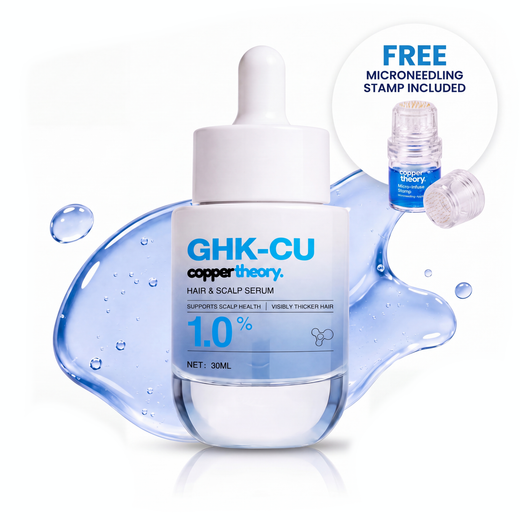
GHK-Cu Copper Peptide Hair Growth Serum for Thinning Hair & Hair Density
The targeted leave-on GHK-Cu scalp step for thinning hair, hair density and hair growth routines.
View product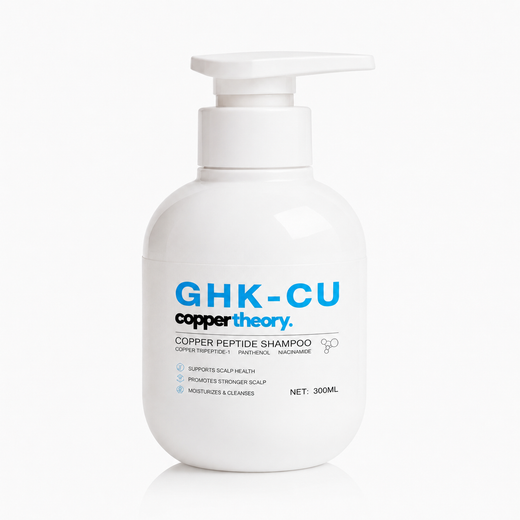
GHK-Cu Hair Growth Shampoo for Cleaner Scalp & Stronger Hair
The cleansing step for wash days before conditioner and scalp serum.
View product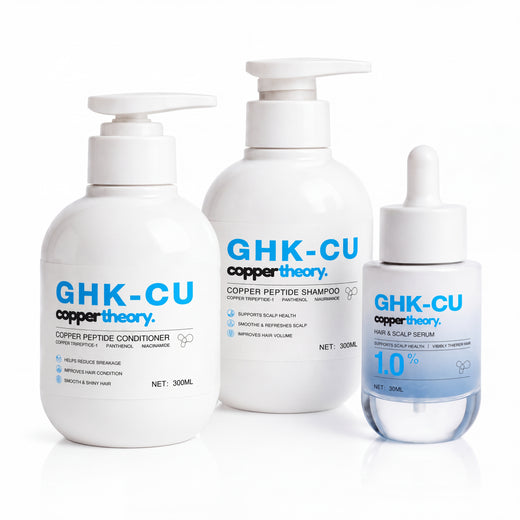
Complete 3-Step GHK-Cu Hair Growth Routine for Thinning Hair
Shampoo, conditioner and serum in one organized hair and scalp routine.
View productCopper Peptides for Hair Growth and Hair Loss: Complete Topical Guide FAQ
Do copper peptides regrow hair?
Current research does not justify a guaranteed human hair-regrowth claim for a cosmetic copper peptide product.
Can GHK-Cu help thinning hair?
It can be used as a topical scalp-care step within a thinning-hair and hair-density routine, with realistic expectations.
Is GHK-Cu the same as minoxidil?
No. Minoxidil is a drug with human clinical evidence and label directions; GHK-Cu serum is a cosmetic scalp product.
Where do I apply a hair serum?
Part the hair and apply the leave-on serum directly to the scalp focus areas rather than coating the lengths.
How long should I assess a routine?
Hair changes slowly. Use consistent monthly photos and follow product directions over months, not days.
Can I use GHK-Cu with minoxidil?
Follow the minoxidil label and seek professional advice. Do not assume every combination is suitable for every scalp.
When should hair loss be assessed?
Seek qualified care for sudden, patchy, painful, inflamed or scarring loss, or when the cause is unclear.
Does this guide include injections?
No. It covers topical cosmetic hair and scalp use only.
Sources and further reading
- Dou et al. — The human tripeptide GHK-Cu in prevention of oxidative stress and degenerative conditions (PMID 35083444)
- Pickart et al. — Regenerative and protective actions of the GHK-Cu peptide in the light of the new gene data (PMID 29986520)
- Topical GHK-Cu delivery study in a mouse hair-growth model (PMID 38026438)
- US FDA — Minoxidil topical solution prescribing information
- Olsen et al. — Randomized clinical trial of topical minoxidil in male pattern hair loss (PMID 12196747)
Use copper peptides as a disciplined scalp step
Choose a clear routine, apply the serum to the scalp and measure consistency over time. Keep medical diagnosis separate from cosmetic product claims.