
What Is GHK-Cu? Copper Peptide Benefits, Evidence and Topical Use
GHK-Cu is a naturally occurring copper-binding tripeptide also listed in cosmetics as Copper Tripeptide-1. In topical skincare and scalp care, it is used as a cosmetic conditioning ingredient; it is not the same thing as an injectable peptide treatment.
GHK stands for glycyl-L-histidyl-L-lysine. When that three-amino-acid peptide binds copper, the complex is called GHK-Cu. The ingredient has a substantial laboratory and preclinical research history, but evidence for individual finished cosmetic products is more limited. That distinction matters: ingredient research can explain why formulators study GHK-Cu, while a finished serum must still be judged by its complete formula, stability, packaging and real-world use.
This guide explains the terminology, the evidence ladder and how topical Copper Tripeptide-1 fits into a practical skin or scalp routine without turning early-stage science into a medical promise.
GHK, GHK-Cu and Copper Tripeptide-1 explained
GHK is a short peptide made from glycine, histidine and lysine. The histidine portion can bind copper, forming GHK-Cu. Cosmetic ingredient lists normally use the INCI name Copper Tripeptide-1, so a product labelled GHK-Cu may show Copper Tripeptide-1 on the ingredient list.
“Copper peptides” is a broader category term. It should not be assumed that every blue serum, every peptide blend or every product using the words copper peptide contains the same ingredient at the same supplied or finished-product concentration.
What the evidence actually shows
GHK and GHK-Cu have been investigated extensively in laboratory and preclinical research, including work on cell signalling, extracellular-matrix activity, oxidative stress and tissue-remodelling pathways. Reviews collect a wide range of these findings. That research supports continued interest in the ingredient; it does not prove that every retail serum produces the same effects in people.
Direct clinical evidence for finished topical GHK-Cu cosmetics remains limited. A responsible reading separates four levels: ingredient mechanism, laboratory experiments, animal or delivery models, and human trials of a finished formula. Claims should become more cautious—not less—as the evidence moves farther from the exact product being sold.
What GHK-Cu can mean in skincare
In skincare, Copper Tripeptide-1 is used in anti-aging, wrinkles, firmness, hydration and skin-texture routines. Those are legitimate cosmetic goals, but the ingredient should be positioned as part of a complete formula rather than a guaranteed wrinkle remover or a substitute for medical treatment.
Supporting ingredients matter. Humectants can improve hydration, emollients can reduce dryness, and a suitable moisturiser can support the skin barrier. Packaging may reduce repeated air or light exposure, but packaging alone does not prove stability; finished-product testing is stronger evidence.
What GHK-Cu can mean for hair and scalp routines
Topical GHK-Cu also appears in scalp and hair-growth-support products. Laboratory and animal research is interesting, including a topical delivery study in a mouse model, but this is not equivalent to human clinical proof of hair regrowth. A cosmetic serum can still have a clear role: a leave-on scalp step for people building a routine around thinning hair, hair density and scalp care.
Keep the product on the scalp rather than the hair lengths, use it consistently and separate cosmetic expectations from diagnosis or treatment of hair loss. Sudden, severe or patchy hair loss warrants qualified medical advice.
How to read a GHK-Cu product label
Check for Copper Tripeptide-1 in the ingredient list, then read the entire formula. A percentage can refer to pure raw active, a supplied solution or blend, or the finished product. “1% complex” does not automatically mean 1% pure GHK-Cu.
- Look for a complete ingredient list and clear directions.
- Check whether the product is designed for face, scalp or both.
- Prefer precise cosmetic claims over guaranteed outcomes.
- Check current price, stock, shipping and returns on the product page.
- Patch test a new topical product before broad use.
How to use topical GHK-Cu
For the face, apply a thin layer after cleansing and before moisturiser, following the product directions. During the day, finish with sunscreen. For the scalp, part the hair and apply the leave-on serum directly to clean, dry or towel-dried scalp focus areas.
Compatibility depends on the exact formulations and manufacturer instructions. Some brands advise separating copper peptides from direct acids, retinoids or strong vitamin C formulas. If directions conflict, follow the product-specific instructions or alternate routines.
What GHK-Cu is not
Topical cosmetic GHK-Cu is not an injectable protocol, not dosage guidance and not a medicine. It should not be presented as guaranteed hair regrowth, a cure for alopecia, permanent wrinkle removal or a treatment for acne.
It is also not a reason to ignore the rest of a formula. An impressive ingredient name cannot compensate for unsuitable directions, incomplete disclosure, poor tolerance or claims that outrun the evidence.
The practical conclusion
GHK-Cu is a well-studied peptide complex with a credible scientific rationale and an established cosmetic identity as Copper Tripeptide-1. Its strongest responsible use is as one part of a clearly formulated topical routine.
Choose the product according to the job: face serum for anti-aging, wrinkles, firmness and hydration; hair serum for a leave-on scalp step within a hair growth and hair-density routine. Then judge the full formula, instructions and consistency—not the ingredient name alone.
Choose the right topical GHK-Cu pathway
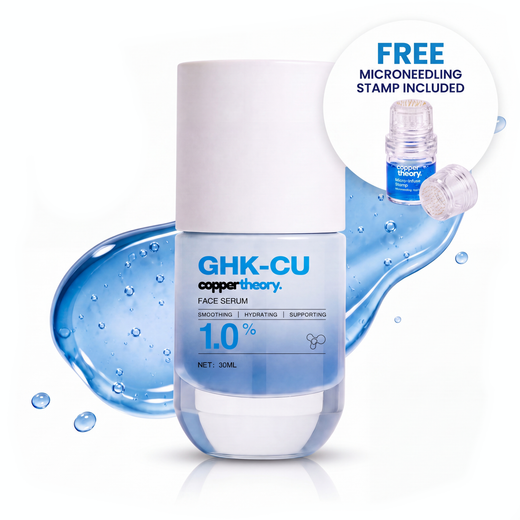
GHK-Cu Copper Peptide Anti-Aging Face Serum for Firm, Clear Skin
Topical GHK-Cu face serum for anti-aging, wrinkles, firmness and hydration routines.
View product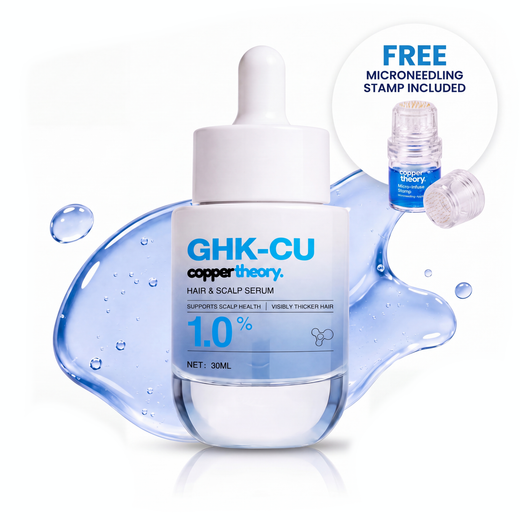
GHK-Cu Copper Peptide Hair Growth Serum for Thinning Hair & Hair Density
Leave-on GHK-Cu scalp serum for thinning hair, hair density and hair growth routines.
View product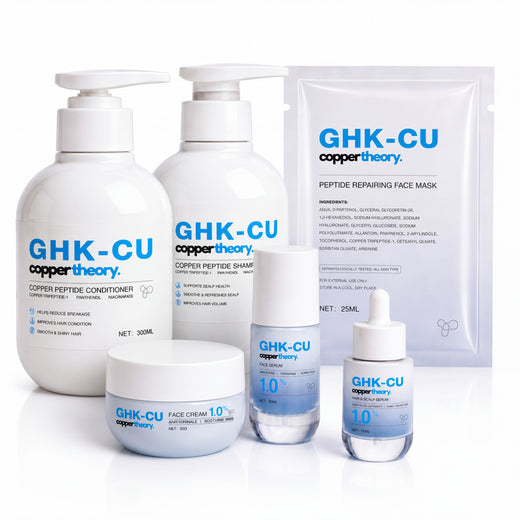
Complete 6-Piece GHK-Cu Skin, Hair & Scalp Routine
A combined CopperTheory skin, hair and scalp routine.
View productWhat Is GHK-Cu? Copper Peptide Benefits, Evidence and Topical Use FAQ
Is GHK-Cu the same as Copper Tripeptide-1?
Yes. Copper Tripeptide-1 is the cosmetic ingredient name commonly used for GHK-Cu on an INCI list.
Is GHK-Cu a copper peptide?
Yes. GHK-Cu is a copper-binding tripeptide and is commonly described as a copper peptide.
Is topical GHK-Cu the same as an injection?
No. A topical cosmetic is applied to skin or scalp. This guide does not provide injectable or dosage instructions.
Does GHK-Cu guarantee hair growth?
No. Preclinical research does not establish guaranteed human hair regrowth from a retail cosmetic serum.
Can GHK-Cu remove wrinkles?
It can be used within an anti-aging routine for wrinkles and firmness, but it cannot guarantee permanent wrinkle removal.
What percentage of GHK-Cu should a serum contain?
A percentage is meaningful only when the supplier basis is clear. It may describe pure active, a supplied blend or the finished product.
Can GHK-Cu be used every day?
Follow the exact product directions and adjust frequency for tolerance. Patch testing is sensible when introducing a new topical formula.
Where should I start?
Start with the goal: a face serum for skincare or a scalp serum for hair and scalp care, then read the complete product directions.
Sources and further reading
- Dou et al. — The human tripeptide GHK-Cu in prevention of oxidative stress and degenerative conditions (PMID 35083444)
- Pickart et al. — Regenerative and protective actions of the GHK-Cu peptide in the light of the new gene data (PMID 29986520)
- Topical GHK-Cu delivery study in a mouse hair-growth model (PMID 38026438)
Choose topical GHK-Cu by purpose
Use the face pathway for skincare goals and the scalp pathway for hair and scalp goals. The exact product page remains the source of truth for formula, stock, price and directions.