GHK-Cu Clinical Studies - What the Research Says
This page gives plain-English context on GHK-Cu as a studied copper peptide, then connects that background to how CopperTheory uses it in topical skincare and connects the research to practical topical use.
CopperTheory products are topical cosmetic skincare and haircare. Nothing here is a promise of a specific clinical result for any individual.

Clear answer
GHK-Cu, or copper tripeptide-1, is a naturally occurring copper-binding peptide that has been studied in the context of skin and copper peptides. It is used cosmetically as a topical ingredient rather than by injection.
CopperTheory's role is straightforward: use GHK-Cu as the focused copper peptide step in leave-on skincare and scalp care, and be transparent that these are cosmetic products, not treatments.
The goal is a routine you can repeat: cleanse, apply the focused serum step, add moisturising support, and avoid adding too many strong products before you know how your skin responds.
Key points
- The direct answer to the question
- What is being explained or compared
- The type and strength of supporting evidence
- Important limits or uncertainty
- The practical takeaway without overclaiming
What this means in plain English
In plain English, the research provides the scientific foundation for topical formula design. Finished-product results then reflect formula quality, correct use, routine consistency and individual response over time.
The practical takeaway is to use GHK-Cu as a consistent step in a simple routine and judge it over weeks and months, not from a single application.
What it is
Start by defining the ingredient, structure, product category or route being discussed.
What evidence can show
Separate laboratory, preclinical, human, regulatory and professional guidance according to what each source actually supports.
What it cannot prove
Ingredient research or a mechanistic explanation does not automatically prove a finished product will deliver a guaranteed outcome.
Practical context
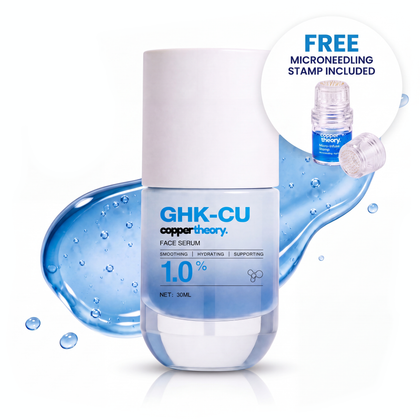
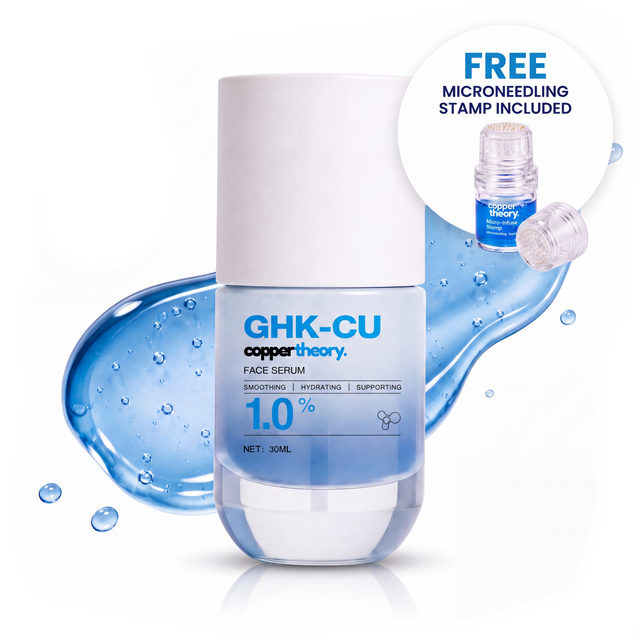
The cleanest skincare order is cleanse first, apply GHK-Cu Face Serum as the copper peptide step, then follow with GHK-Cu Face Cream or moisturiser. In the morning, sunscreen should be the final step.
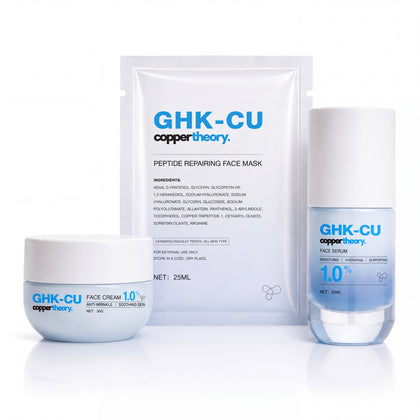
For skin goals, the hero product is GHK-Cu Face Serum. GHK-Cu Face Cream supports hydration and comfort, while the Complete GHK-Cu Skincare Routine makes the order easier to follow.
Key points
- Define the exact question before comparing evidence.
- Separate topical cosmetics from injections, medicines and clinical procedures.
- Distinguish ingredient-level findings from evidence on a finished formula.
- Consider concentration, delivery, contact time and study population.
- Use a qualified professional for medical decisions rather than extending cosmetic guidance beyond its scope.
What to compare and what to keep separate
GHK-Cu Face Serum pairs best with gentle cleansing, hydration, face cream and sunscreen. Niacinamide, panthenol, allantoin and sodium hyaluronate-style hydration can support a simple routine. Retinol, strong acidic vitamin C and exfoliating acids should be introduced carefully, especially on sensitive skin.
If the routine starts feeling dry, tight, itchy, greasy or overloaded, reduce the number of steps first. A simpler routine is usually easier to judge than a routine with too many new products overlapping at once.
Compare like with like
Compare evidence from similar routes, formulations, populations and outcomes rather than combining unlike categories.
Separate mechanism from outcome
A plausible biological mechanism can support a hypothesis without proving a visible or clinical result in a finished product.
Keep scope visible
Cosmetic education can explain topical use, but diagnosis, injections, medicines and treatment decisions require qualified professional guidance.
Common mistakes to avoid
Most weak routines fail because the product order is unclear. The customer uses the right ingredient in the wrong place, stacks too many products or stops before there is enough consistency to judge.
Avoid these mistakes if you want the CopperTheory routine to feel clean, repeatable and easy to understand.
Key points
- Treating ingredient research as finished-product clinical proof
- Treating laboratory or preclinical findings as confirmed human outcomes
- Comparing topical cosmetics directly with injections, medicines or procedures
- Ignoring formulation, concentration, delivery and contact time
- Turning uncertainty into a guaranteed claim or forced product conclusion
How to judge the evidence without guessing
Do not judge a GHK-Cu routine from one use. In the first week, judge comfort, product feel and whether the order makes sense. Around 30 days, judge consistency, hydration, texture, scalp comfort or haircare discipline. Longer routines are easier to assess when you have not changed every product at once. The evidence base includes a PubMed review of GHK/GHK-Cu research and a review of GHK-Cu regenerative and protective research. CopperTheory connects that ingredient research to its tested, verified and disclosed topical formula.
For hair and scalp routines, patience matters even more because hair cycles are slow. The goal is a repeatable scalp-first routine assessed over hair-cycle timeframes through consistent placement and tracking.
Evidence type
Identify whether a source is laboratory, preclinical, human, regulatory or professional guidance.
Product relevance
Check whether the evidence concerns the same ingredient, concentration, delivery route, formula and outcome being discussed.
Conclusion strength
State what is supported, what is only plausible and what remains unknown instead of presenting all evidence as equal.
Who this guide is for
This topic is best for customers who want a clear GHK-Cu routine instead of guessing between products. It is useful if you want to understand copper peptides, Copper Tripeptide-1, skincare order, scalp serum use, product pairing or which CopperTheory product to start with.
This guide provides practical topical-product and routine guidance grounded in the ingredient roles, formula design and evidence discussed throughout the page.
Key points
- People comparing ingredients, product categories or delivery routes
- People trying to understand the strength of a claim
- People separating cosmetic guidance from medical discussion
- People who want uncertainty and evidence limits stated clearly
- People deciding what the available evidence means in practice
Key summary
This page provides research context for GHK-Cu and links to the practical CopperTheory pathways for skin and hair, where the ingredient is actually used.
Use it to understand why copper peptides are studied, then follow the skin or hair pathway to put GHK-Cu into a real routine.
Continue with the relevant evidence and practical context
The products and guides below are included only where they directly relate to the question explained on this page.

GHK-Cu Face Serum
The hero GHK-Cu copper peptide skincare step for texture, hydration, visible firmness and daily routine support.
Shop GHK-Cu Face Serum
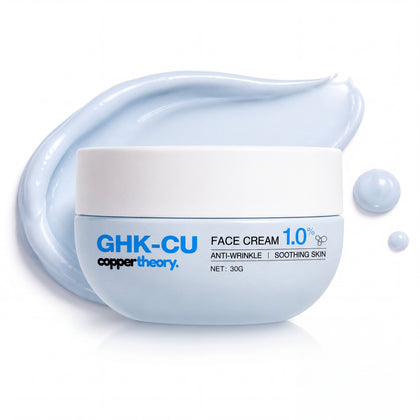
GHK-Cu Face Cream
The moisturising step after serum for comfort, hydration and barrier support.
Shop GHK-Cu Face Cream
Complete GHK-Cu Skincare Routine
The complete CopperTheory skincare order when you want cleanser, serum, cream and support steps together.
Shop Complete GHK-Cu Skincare RoutineHow to Use GHK-Cu Face Serum
Turn copper peptide skincare into a simple cleanse, serum and cream routine.
Read: How to Use GHK-Cu Face SerumHow to Layer GHK-Cu Serum
Place GHK-Cu in the right order so the routine stays simple and repeatable.
Read: How to Layer GHK-Cu SerumWhat Not to Mix With Copper Peptides
Avoid overcrowding your routine with too many strong steps at once.
Read: What Not to Mix With Copper PeptidesCopper Peptides With Moisturiser
Pair your serum with the comfort step that helps the routine feel complete.
Read: Copper Peptides With MoisturiserSkin Barrier Explained
Understand why comfort, moisturiser and consistency matter around active-style products.
Read: Skin Barrier ExplainedCopper Peptides for Skin
See how copper peptide skincare connects to texture, hydration, firmness and routine order.
Read: Copper Peptides for SkinSources and further reading
Inline citations connect specific statements to primary research, regulatory documents or professional guidance. CopperTheory’s current ingredient lists and formula records are tested, verified and disclosed; the source labels below show whether the supporting evidence is ingredient-level, preclinical, human, regulatory or professional guidance.
GHK-Cu Clinical Studies - What the Research Says FAQ
What is GHK-Cu and why is it studied in cosmetic science?
GHK-Cu, also called Copper Tripeptide-1, is a copper-binding peptide studied in skin and topical-formulation research. CopperTheory uses it as a topical cosmetic ingredient in skincare and scalp-care formulas; the research context explains why the ingredient is of interest, not a guaranteed result from a finished product.
Do ingredient studies prove that a finished CopperTheory product works?
No. Ingredient research can support the scientific rationale for using GHK-Cu, but it does not by itself prove the performance of a finished CopperTheory formula. Finished-product results, formula records, concentration verification and batch documentation are separate evidence types and should be judged separately.
What does the research on this page actually support?
The cited research provides context on copper-peptide biology, topical delivery and related peptide research. It is used to explain ingredient and formulation rationale. CopperTheory does not treat an ingredient study as proof that every finished product will produce the same outcome in every person.
How does CopperTheory use GHK-Cu topically?
For skincare, GHK-Cu Face Serum is used after cleansing and before face cream or moisturiser. For scalp care, the leave-in hair serum is applied directly to the target scalp zones. These are topical cosmetic uses rather than injectable or medical uses.
Why is the AHK-Cu hair-follicle study not direct proof for GHK-Cu?
AHK-Cu is a different tripeptide-copper complex from GHK-Cu. Research on AHK-Cu and human hair follicles can provide related mechanistic context, but it should not be presented as direct clinical proof for GHK-Cu or for a finished CopperTheory hair product.
What are the main limits of the clinical evidence discussed here?
The page distinguishes ingredient research from finished-product evidence and does not promise a specific clinical outcome. Study design, ingredient identity, concentration, delivery system, endpoint and timeframe all matter, so evidence from one ingredient or procedure should not be generalized beyond what it actually tested.
Where can I verify CopperTheory finished-product evidence and concentration claims?
Use the Product Testing and Verification page, the GHK-Cu concentration-verification page, the COA and Testing FAQ, the relevant product-results page and the current live product page. Together they separate formula composition, batch documentation, finished-product results and current product information.
How long should a topical GHK-Cu routine be judged before drawing conclusions?
Judge immediate factors such as comfort and product feel first, then assess routine consistency and cosmetic changes over longer periods. Hair and scalp routines need particular patience because hair cycles are slow. A single application is not enough to judge a long-term routine.
Build your CopperTheory skincare routine
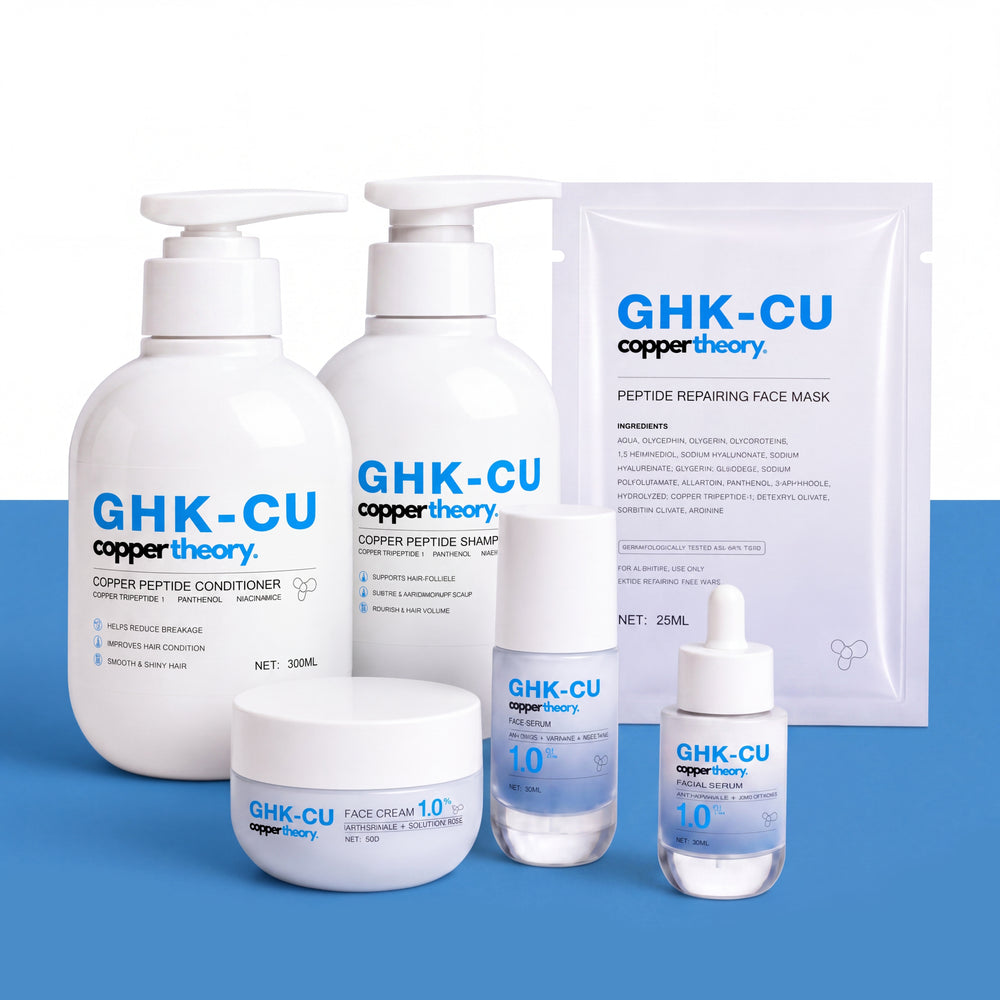
Explore the Anti-Aging Face Serum and Firming Face Cream for skin, or the GHK-Cu Hair Growth Serum for scalp care — all built around topical GHK-Cu.
Primary research and evidence context
These external papers provide ingredient or delivery context for copper-peptide research. They are not presented as proof of the finished CopperTheory formulas, and they do not replace product-specific testing or batch documentation.
- Topical GHK-Cu delivery study — PubMed
- AHK-Cu and human hair follicles — PubMed (a different tripeptide-copper complex; included only as related copper-peptide research)
- Acetyl Tetrapeptide-3 research — PubMed