Skip to content
CopperTheory Ingredient Guide

Best Copper Peptide Serum Ingredients: What to Look For in a GHK-Cu Formula

What makes a copper peptide serum worth buying?

A copper peptide serum is worth buying when it is built around Copper Tripeptide-1 (GHK-Cu) as the clearly identified hero ingredient, in a simple, stable, fragrance-light formula, and surrounded by supporting ingredients that hold hydration and comfort rather than crowding the peptide out. GHK-Cu is a naturally occurring human copper peptide — glycyl-L-histidyl-L-lysine bound to copper. The goal is not the longest ingredient list; it is one well-formulated GHK-Cu step you can tolerate and repeat.

Everything a copper peptide serum does is cosmetic support used consistently over time. For skin, that means a product formulated for anti-aging concerns such as wrinkles, firmness and uneven skin texture. For scalp and hair, it means a product intended for people concerned about thinning hair, hair density and hair growth. None of it is a medical treatment or a guaranteed result. This guide shows exactly what to check on a label, what the evidence does and does not show, which supporting ingredients belong in a strong formula, how a face serum differs from a hair or scalp serum, and the warning signs that separate honest copper peptide skincare from marketing.

Quick links: GHK-Cu Face Serum · GHK-Cu Hair Serum · What Is GHK-Cu? · Ingredient Transparency

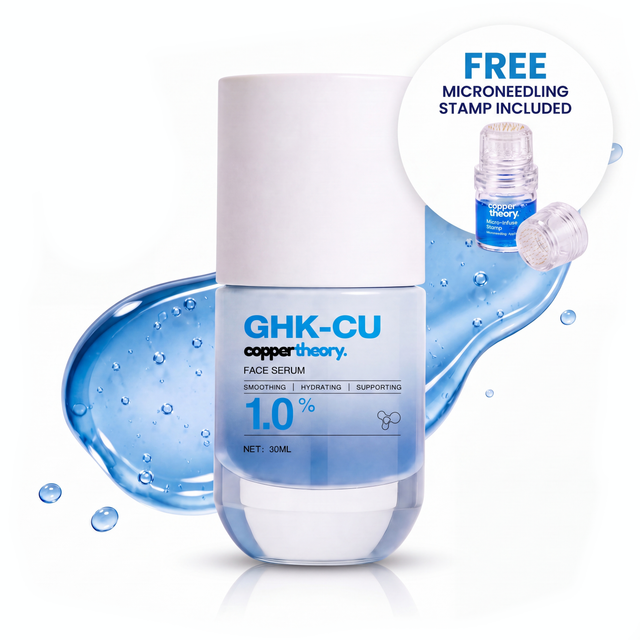
GHK-Cu Copper Peptide Anti-Aging Face Serum for Firm, Clear Skin

GHK-Cu and Copper Tripeptide-1 explained

GHK-Cu and Copper Tripeptide-1 are two names for the same cosmetic ingredient. “Copper Tripeptide-1” is the INCI (label) name; “GHK-Cu” is the shorthand the category is named after. It is a small peptide — glycyl-L-histidyl-L-lysine — complexed with copper. If a product lists one name but not the other, they still refer to the same ingredient. For the full background, see What Is GHK-Cu?

A topical copper peptide serum delivers this ingredient onto the skin or scalp in a leave-on cosmetic base. That distinction matters: topical copper peptides are cosmetic skincare, and are not the same as injectable peptides. Any product that borrows injectable or dosage language to describe a serum you apply to the surface is mixing two very different categories — a point the warning signs section returns to.

A copper peptide face serum and a copper peptide hair or scalp serum share the same hero ingredient but are formulated for different jobs and different areas. The dedicated comparison below breaks this out.

What does the evidence actually show about GHK-Cu?

Copper peptide marketing often blurs several different kinds of evidence together. It helps to keep four categories separate:

  1. Evidence about GHK or GHK-Cu as an ingredient — research on the molecule itself.
  2. Laboratory, animal or other preclinical evidence — cell-culture or animal models, not finished cosmetics used by real people.
  3. Limited human research — smaller studies in people.
  4. Evidence for a specific finished cosmetic product — testing of an actual serum as it is sold.

GHK is naturally present in human plasma, and published research reports that circulating levels decline with age. GHK and GHK-Cu have been investigated extensively in laboratory and preclinical research, but direct clinical evidence for finished topical GHK-Cu cosmetics remains limited. Ingredient research can justify scientific interest in GHK-Cu, but it cannot prove that every finished serum produces the same outcome.

The practical takeaway: when you read a copper peptide claim, ask which of the four categories it comes from. A promising ingredient study is not the same as proof that one particular bottle will deliver that result on your skin or scalp. The two PubMed-indexed references in the Sources section are examples of the ingredient-level research on GHK and GHK-Cu.

Copper peptide serum buyer’s checklist

Use this checklist to judge any copper peptide serum — CopperTheory’s or anyone’s — on the whole formula rather than the headline claim:

  1. A clearly disclosed INCI list. The full ingredient list should be visible and readable. A brand that hides or vaguely summarises its formula makes it impossible to judge. See how CopperTheory approaches this on the Ingredient Transparency page.
  2. Copper Tripeptide-1 / GHK-Cu clearly identified. The hero peptide should be named as Copper Tripeptide-1 (with GHK-Cu as the common name), not buried inside a proprietary “complex” with nothing disclosed.
  3. Purposeful supporting ingredients. Look for a short, sensible support cast of hydration and soothing actives. The longest ingredient list is not the best one; quality and purpose beat sheer quantity.
  4. Formulation stability. Copper peptides perform best in a stable, well-considered base — but a simple formula is not automatically stable. Finished-product stability and compatibility testing provide stronger evidence than the outward appearance of a formula, and you usually cannot verify a brand’s private testing from the label alone. Look for clear storage and use instructions as a sign the brand has thought about it.
  5. Packaging. Pumps, opaque containers and well-sealed packaging may reduce exposure to air or light and can support product protection. Packaging alone does not prove a formula is stable — treat it as one helpful signal, not proof.
  6. A clear product purpose. The label should tell you whether it is a face serum, a hair or scalp serum, a cream or a cleanser, and what area it is for, so you can match it to your actual need.
  7. Fragrance and irritation considerations. Many people prefer a fragrance-light formula, because added scent gives no active benefit and can bother sensitive skin or scalp. This matters most if you react easily.
  8. Realistic usage instructions. Good products explain how and when to apply, and set honest expectations of consistent use over weeks, rather than implying an overnight change.
  9. Transparent claims. Benefit language should be honest and specific — not “clinically proven [x]%” without finished-product evidence, and not a promise of guaranteed outcomes.
  10. Patch-test guidance. Responsible brands suggest patch testing when you introduce new skincare or scalp care, especially for reactive skin. For practical routine guidance, see the Compatibility Chart and What Not to Mix With Copper Peptides.

Supporting ingredients commonly found in good formulas

Around the GHK-Cu hero step, the supporting cast is what keeps a serum hydrating, comfortable and repeatable. Common, sensible choices include:

  • Peptides — some formulas pair copper peptides with other peptides; the point is complementary support, not a race to list as many as possible. For how copper peptides differ from other peptide terms, see Copper Peptides vs Regular Peptides.
  • Niacinamide — widely used for barrier and skin-texture support.
  • Panthenol (provitamin B5) — a conditioning, soothing humectant.
  • Hyaluronic acid / sodium hyaluronate — lightweight hydration that holds water in the skin.
  • Allantoin — a classic soothing, comforting ingredient.
  • Other compatible hydrating and soothing ingredients — foundational humectants such as glycerin and butylene glycol, for example, that support hydration alongside the peptide.

These are ingredients commonly found in well-built formulas — not a mandatory list, and not every good serum contains every one of them. There is also no single “correct” concentration you should demand; a balanced, tolerable formula you actually keep using matters more than any one number on the label. You can look up individual ingredient roles in the Ingredient Dictionary.

Copper peptide face serum vs copper peptide hair serum

The most common point of confusion is assuming a copper peptide serum is one universal product. It is not. The hero ingredient is shared, but the formula, texture and intended area differ:

  • A face serum (like the GHK-Cu Face Serum) is formulated for facial skin — anti-aging concerns such as wrinkles, firmness and uneven skin texture, plus everyday comfort. It is made to layer under a moisturiser and, in the daytime, sunscreen.
  • A hair or scalp serum (like the GHK-Cu Hair Serum) is formulated to sit on the scalp and support the scalp environment, and is intended for people concerned about thinning hair, hair density and hair growth. Its base and application are built for the scalp, not the face.

Choosing between them is simply a question of which area you are treating. If your concern is facial skin, choose the face serum; if your concern is your scalp and hair, choose the hair serum. Some people use both, in their respective routines.

Quick comparison: face serum vs hair serum

Copper Peptide Face Serum Copper Peptide Hair / Scalp Serum
Intended area Facial skin Scalp and hair
Main purpose Formulated for anti-aging concerns such as wrinkles, firmness and uneven skin texture, plus comfort Intended for people concerned about thinning hair, hair density and hair growth
Texture Lightweight leave-on facial serum Scalp-appropriate leave-on serum
How it is applied After cleansing, before moisturiser (and sunscreen in the day) Applied to the scalp as directed, worked into the hair and scalp
Supporting ingredients to look for Hydration (glycerin, sodium hyaluronate), soothing (panthenol, allantoin), niacinamide Scalp-comfortable hydrating and soothing ingredients suited to leave-on scalp use
CopperTheory option GHK-Cu Face Serum GHK-Cu Hair Serum

Warning signs to avoid

Some products lean on language that sounds impressive but should make you cautious. Treat these as reasons to look closer, not as claims to trust:

  • Undisclosed ingredients. No full INCI list, or a “proprietary complex” with nothing disclosed, means you cannot judge the formula.
  • Injectable or dosage positioning on a cosmetic product. A topical serum is not an injectable peptide. Framing a leave-on cosmetic with injection or “dosage” language blurs a line that should stay clear.
  • Unsupported clinical percentages. A phrase like “clinically proven to do X by Y%” is only meaningful with finished-product evidence behind it. Treat unbacked percentages as marketing.
  • Guaranteed regrowth. No topical cosmetic can honestly promise guaranteed hair regrowth, reverse hair loss, or treat conditions such as alopecia — those are medical claims a cosmetic should not make.
  • Guaranteed wrinkle removal. In the same way, no serum can honestly guarantee it removes or “erases” wrinkles. Honest, qualified language about firmness and skin texture is fair; a promise to erase wrinkles is not.
  • Vague or misleading copper-peptide labelling. A blue tint, or the word “peptide” on the front, is not proof of a well-identified, well-supported GHK-Cu formula. A darker blue colour does not automatically mean a stronger or better serum — the colour comes from copper and can vary with the specific ingredient and formula. Check the actual INCI list.

How to use a copper peptide serum in a routine

If you are building around GHK-Cu for skin, the hero step is a face serum after cleansing. Follow with a moisturiser or the GHK-Cu Face Cream for comfort and barrier support, and use sunscreen during the day. The Complete GHK-Cu Skincare Routine keeps cleanse, treat and moisturise in the right order, and How to Layer GHK-Cu Serum walks through the sequence. For scalp and hair, the same copper peptide logic runs through the GHK-Cu Hair Serum.

Using copper peptides alongside retinoids, vitamin C or exfoliating acids depends on the exact finished formulations and the manufacturer’s directions — so follow the instructions supplied with your specific products. Some brands recommend separating copper peptides from direct acids, direct vitamin C or retinoids within their own routines; The Ordinary, for example, publishes brand-specific routine guidance on using retinoids (linked in Sources). When reliable compatibility information is not available, or if you have sensitive skin, a cautious option is to use them at different times of day or on alternating days. Introduce strong actives gradually and simplify or pause the routine if irritation occurs. The Compatibility Chart and What Not to Mix With Copper Peptides offer practical routine guidance rather than a medical prohibition.

Judging results honestly: copper peptide skincare is a slow, cumulative story, not an overnight fix. In week one, judge comfort and fit; over the first month, judge consistency, hydration and skin texture; longer term, judge the whole routine rather than a single use. This applies to skin and scalp alike, and it is why Copper Peptides for Skin is framed around steady use.

FAQ

What should I look for in a copper peptide serum?

Look for Copper Tripeptide-1 (GHK-Cu) clearly identified in a fully disclosed INCI list, in a simple, stable, fragrance-light formula, supported by hydration and soothing ingredients rather than a long list of actives crowded into one bottle. A serum you can tolerate and use consistently is more useful than one packed with ingredients you cannot judge.

Is GHK-Cu the same as Copper Tripeptide-1?

Yes. “Copper Tripeptide-1” is the INCI (label) name and “GHK-Cu” is the common shorthand for the same cosmetic ingredient. If a product lists one but not the other, they still refer to the same thing.

What percentage of copper peptide is best?

There is no single “best” number, and a percentage on its own can be misleading. A marketed figure such as “1%” can refer to different things: the raw active peptide, a supplied ingredient solution or blend (where a “1% solution” may contain far less pure peptide), or the finished-product concentration in the bottle. Because those are not the same, a number alone does not tell you how much pure copper peptide you are getting. Formula stability, tolerability and consistent use generally matter more than chasing the highest figure on the label.

Can copper peptides be used every day?

For many people, yes — a well-formulated, fragrance-light copper peptide serum is designed for daily use. Introduce it gradually, keep the surrounding routine simple, and patch test first if your skin or scalp reacts easily.

Can copper peptides be used with retinol, vitamin C or acids?

It depends on the exact finished products and their directions, so follow the instructions supplied with your own products. Some brands recommend separating copper peptides from direct acids, direct vitamin C or retinoids in their specific routines. If clear guidance is not available, or if you have sensitive skin, a cautious approach is to use them at different times or on alternating days, introduce strong actives gradually, and simplify the routine if irritation occurs. See What Not to Mix With Copper Peptides and the Compatibility Chart for practical routine guidance.

Should I choose a face serum or a hair serum?

Choose by the area you are treating. For facial skin concerns — anti-aging, wrinkles, firmness and skin texture — choose a face serum. For scalp and hair concerns — thinning hair, hair density and hair growth — choose a hair serum. Some people use both in their respective routines.

Are blue serums always stronger?

No. The blue tint comes from the copper in copper peptides, but a deeper blue does not reliably mean a higher or more effective peptide level — colour can be influenced by the specific ingredient and formula, not just how much peptide is present. Judge the INCI list and the overall formula, not the shade.

Is this medical advice?

No. This is topical cosmetic skincare, haircare and scalp care education only. CopperTheory products are topical cosmetics — not injectables and not medical treatments.

Next steps

Continue your CopperTheory routine with the most relevant products and guides:

Sources

Choose the right GHK-Cu serum for your routine

Use the face serum for facial skincare concerns, the hair serum for scalp and hair concerns, and the face cream as the moisturising step after serum.